Modified Growth Rates
\[
\omega(k;\epsilon)
= k\Big(
\epsilon_\rho\,\mathrm{Im}\,c^{(0)}_1(k)
\;+\;
\epsilon^2\,\mathrm{Im}\,c^{(2)}(k)
\Big),
\]
where the first term is the classical Miles growth rate ($\epsilon_{\rho} \text{Im } c_1^{(0)}$ comes from another asymptotic expansion, to approximate $\text{Im }c^{(0)}$) and the second term is the leading-order modification dependent on the wave-induced mean flow \(U^{(2)}(b)\) (the dispersion relation ends up being linear in $c^{(2)}$; no approximation is needed here).
1. Growth rates without surface tension
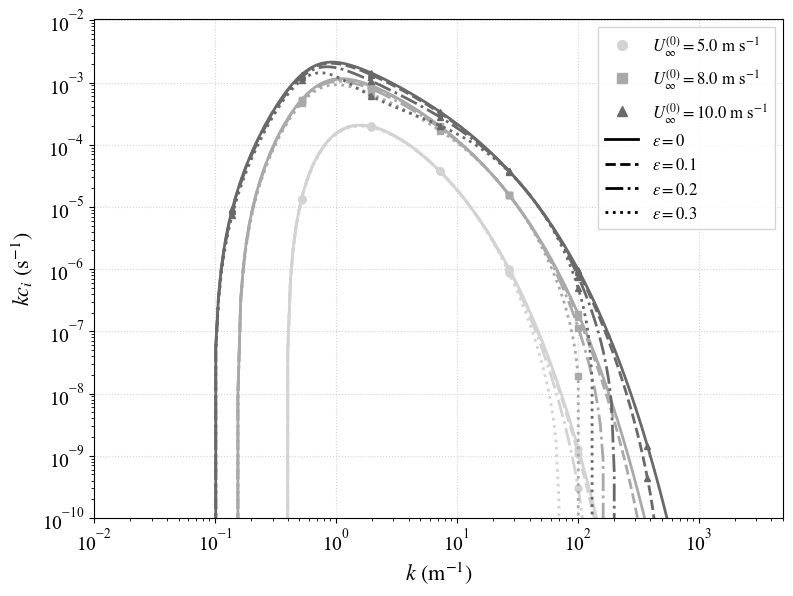
Parameters: Double-exponential wind profile with \(U_s^{(0)} = 0\); \(U_\infty^{(0)} = 5.0,\,8.0,\,10.0~\mathrm{m\,s^{-1}}\); \(\rho_{\text{air}} = 1.25~\mathrm{kg\,m^{-3}}\), \(\rho_w = 1025~\mathrm{kg\,m^{-3}}\); air-layer depth \(h_{\text{air}} = 1~\mathrm{m}\), water depth \(h_w = 0.54~\mathrm{cm}\); wave slopes \(\epsilon = 0,\,0.1,\,0.2,\,0.3\).
- The \(\epsilon = 0\) curves show the Lagrangian formulation reproduces the classical growth rate at leading order.
- As \(\epsilon\) increases, the \(\epsilon^2\,\mathrm{Im}\,c^{(2)}(k)\) term systematically reduces the growth, especially at high wavenumbers.
- Larger \(U_\infty^{(0)}\) corresponds to enhanced background shear, and when it and the wave slope are sufficiently large, there is also significant suppression at intermediate wavenumbers.
- This is on a log scale; the growth reduction is quite substantial, up to nearly a 40% decrease in integrated growth.
2. Growth rates with surface tension
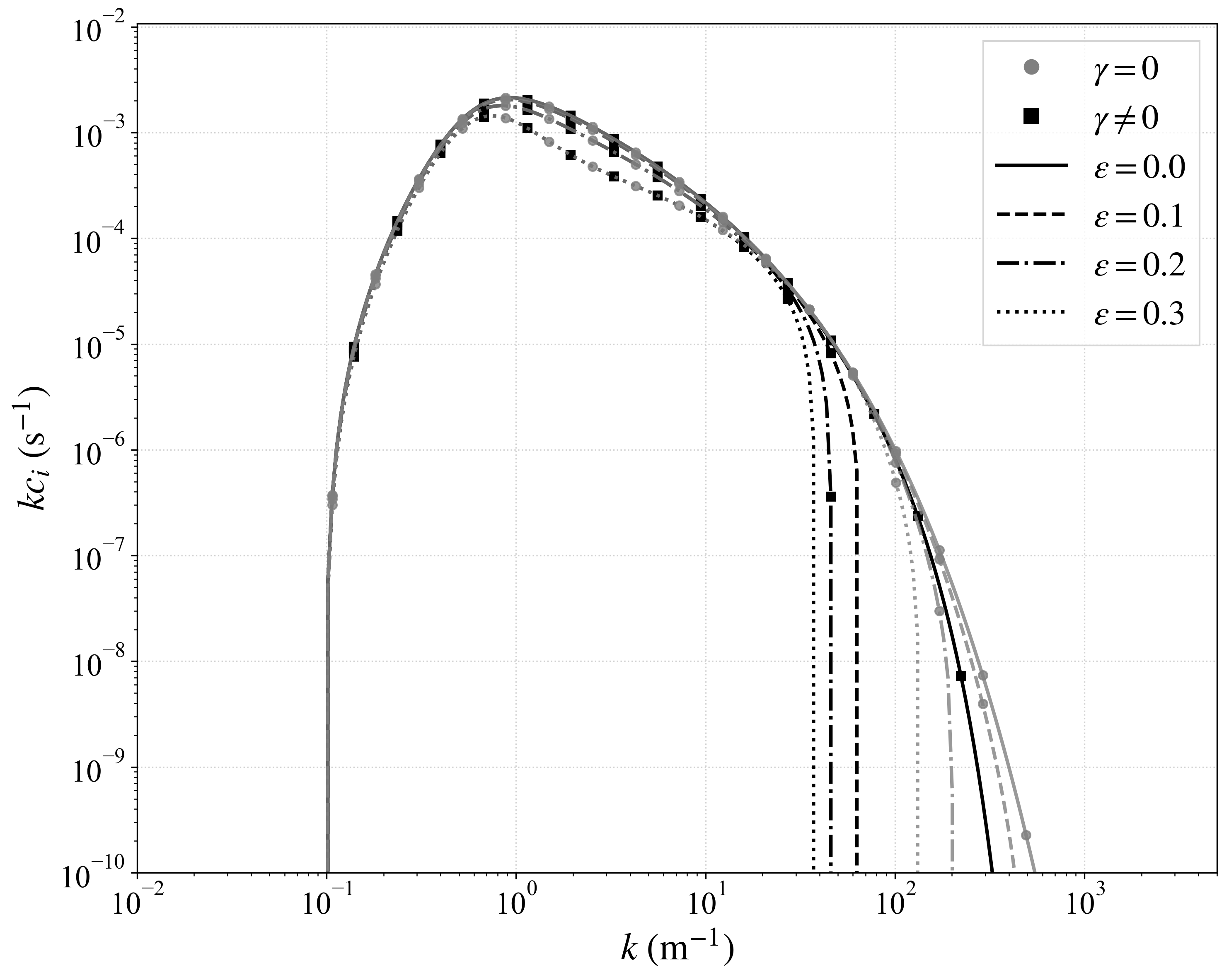
Parameters: Same wind and density parameters as panel 1; far–field wind \(U_\infty^{(0)} = 10.0~\mathrm{m\,s^{-1}}\); surface tension \(\gamma = 7.2 \times 10^{-5}~\mathrm{m^3\,s^{-2}}\) (or $\gamma=0$); wave slopes \(\epsilon = 0,\,0.1,\,0.2,\,0.3\).
- The same growth suppression appears even when surface tension is included; it is not a competing or oveerriding effect
- While intermediate wavenumbers affected by the modified growth rate have the same growth whether surface tension is included or not, the highest wavenumbers are significantly impacted by capillary effects, and the impact also increases with wave slope.