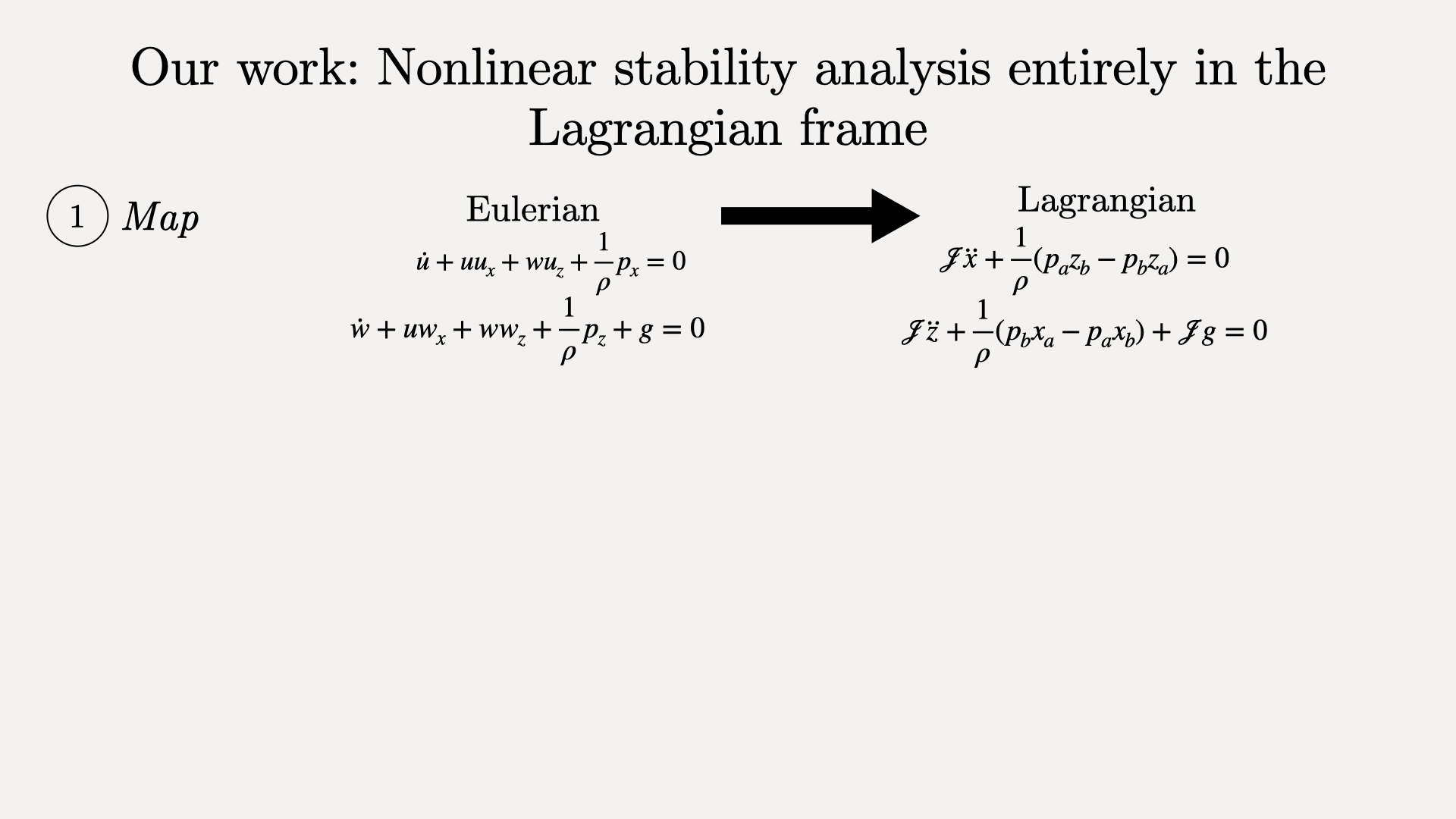
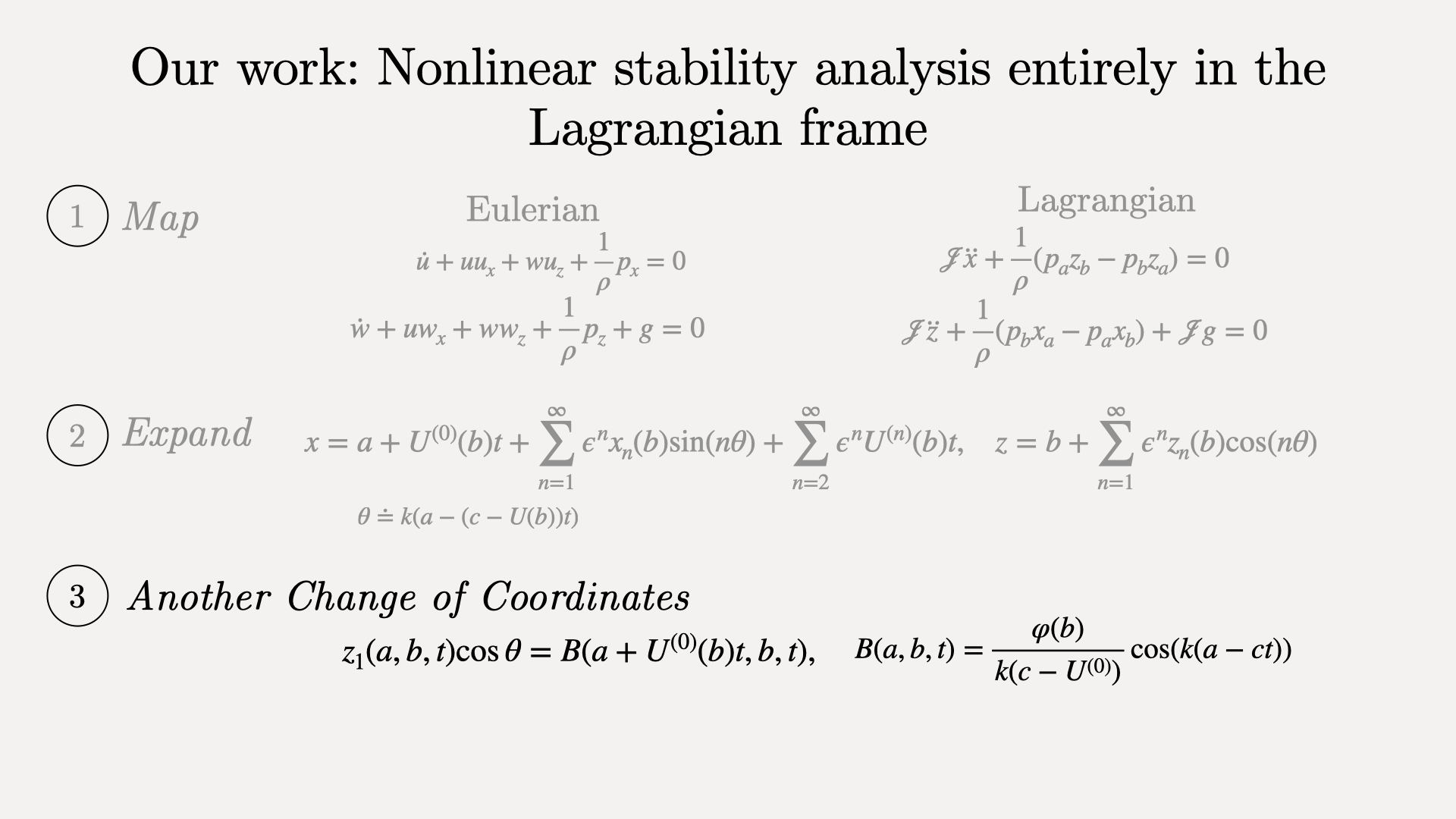
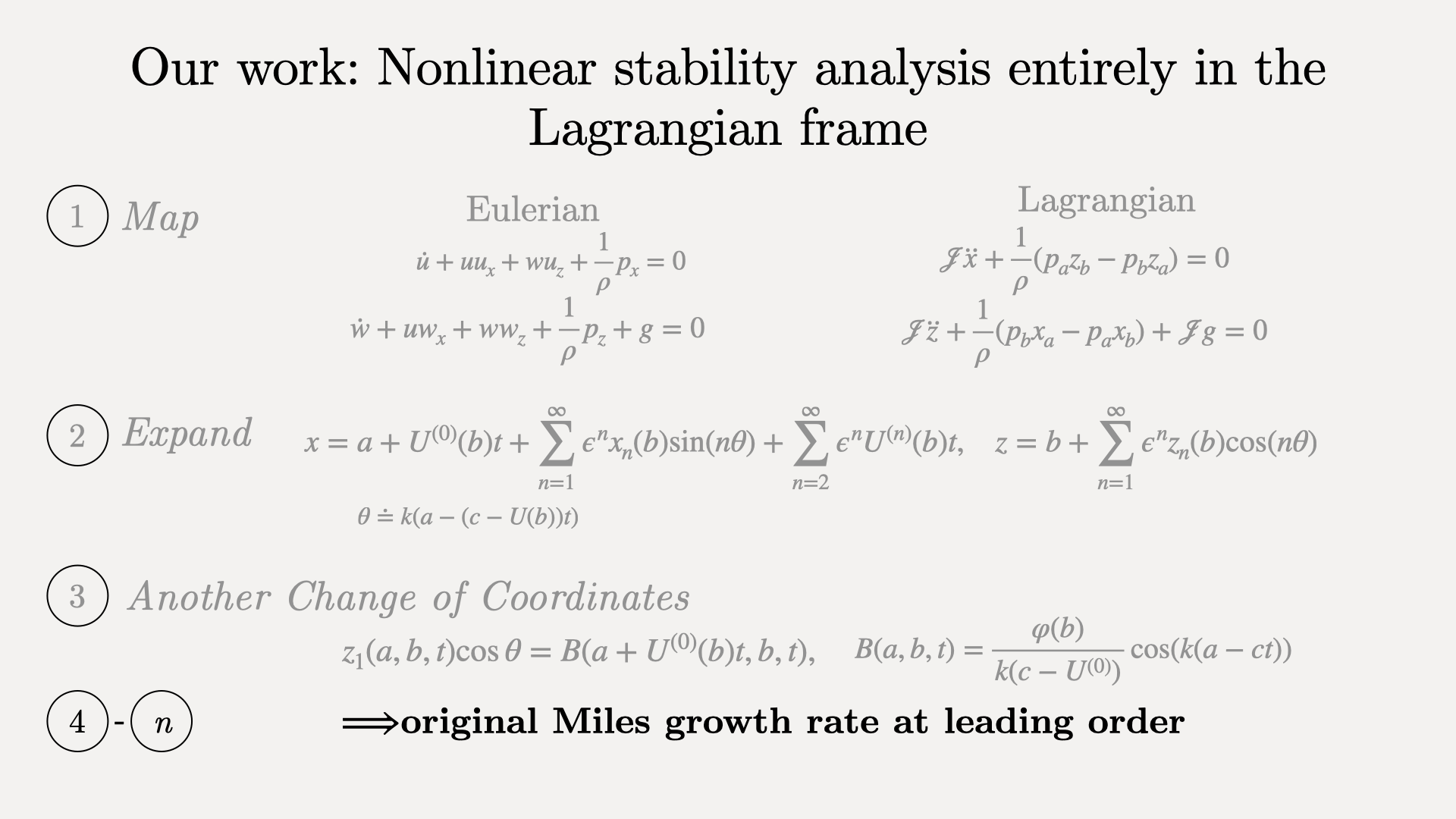
The first step of the math is to map the (Eulerian) Euler equations into the Lagrangian frame.
The equations are very different; it is not a priori clear that we could even reproduce Miles' math in the Lagrangian frame, let alone consider higher orders.
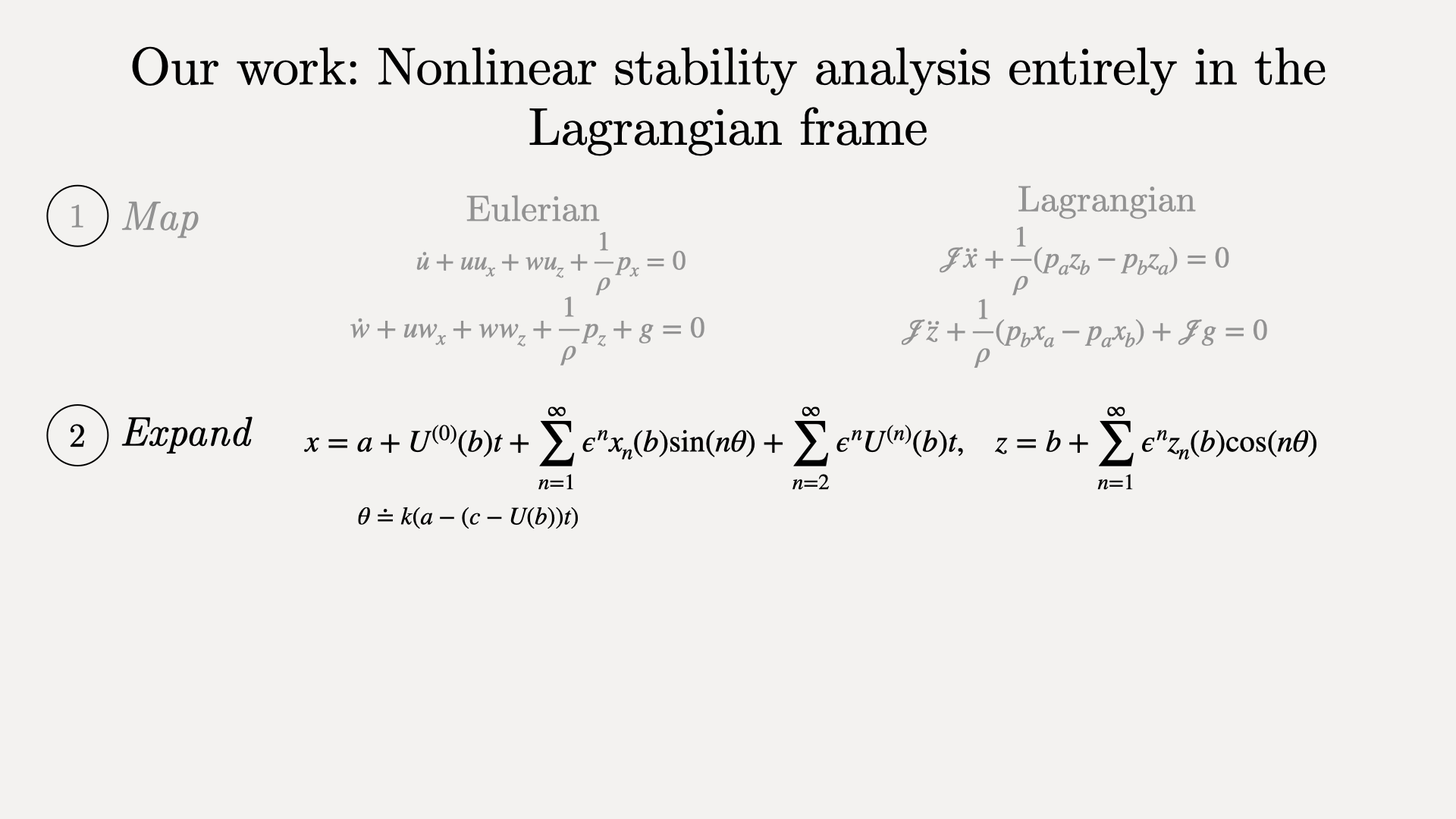
We expand the spatial coordinates of the particles, $x$ and $z$, in terms of monochromatic waves.
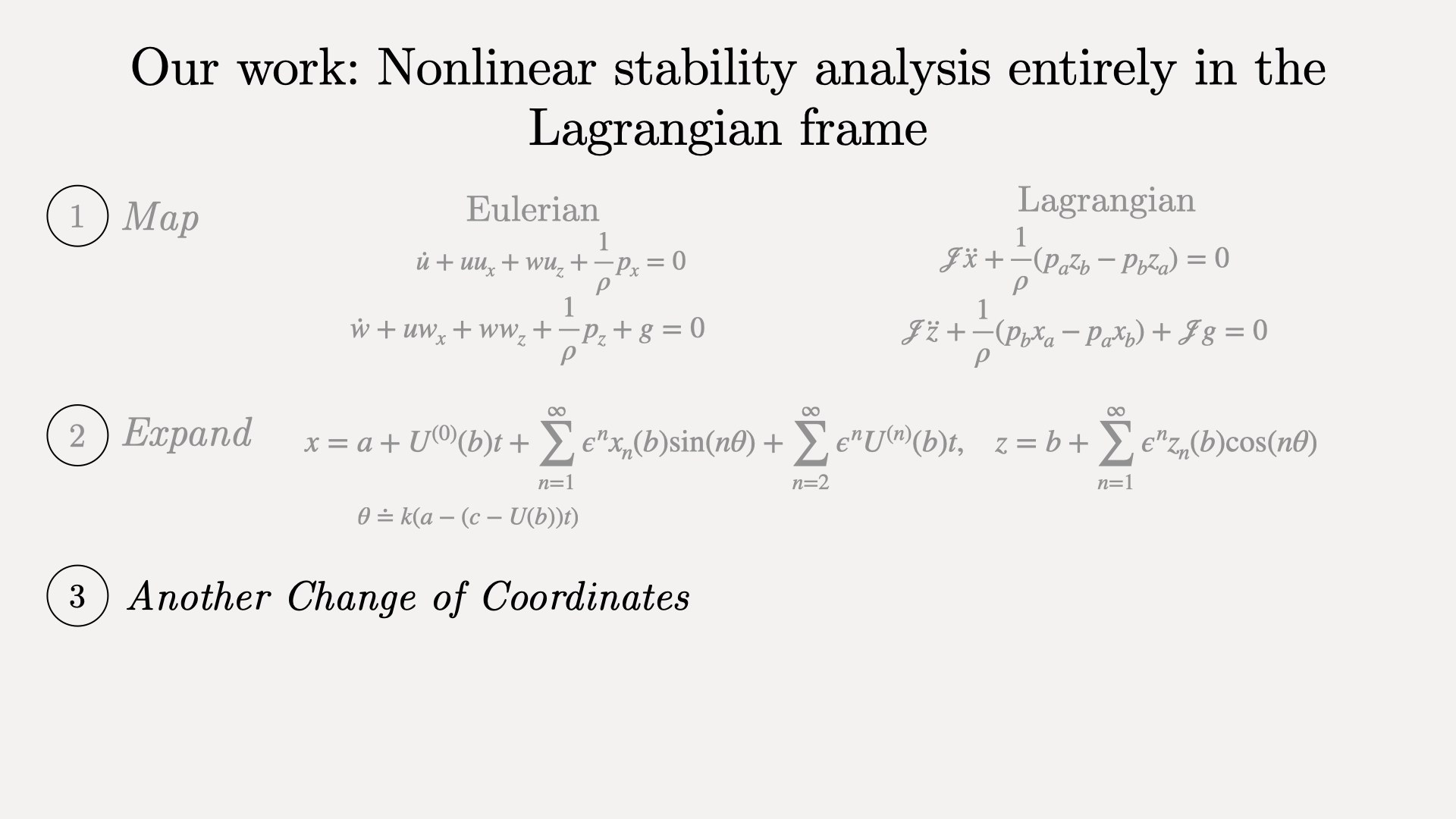
Another change of variables is required just to obtain the Rayleigh equation.
Asymptotic matching and discussion of the small imaginary part of the phase speed.
This change of coordinates, due to Bennett, Lagrangian Fluid Dynamics (2010), is interesting because amplitude is rescaled by the difference between the background/mean velocity and the phase speed of the disturbance!
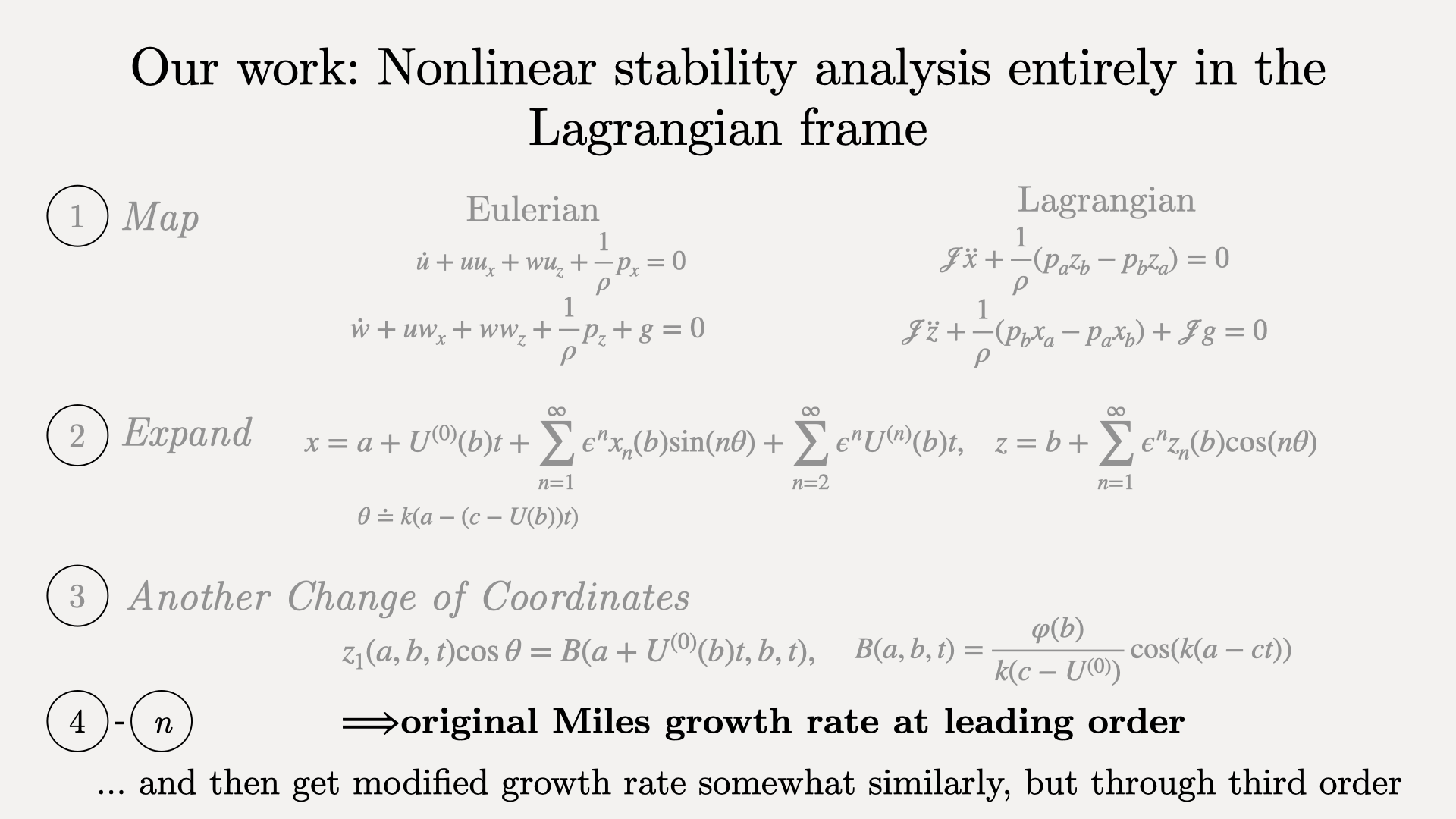
After this, using the boundary conditions at the interface, using conservation laws, more algebra, etc., one can actually recover Miles' growth rate (but in Lagrangian coordinates) as the leading-order solution!
To get the (more interesting) modified growth rate though, one must go to higher orders in the wave slope $\epsilon$.